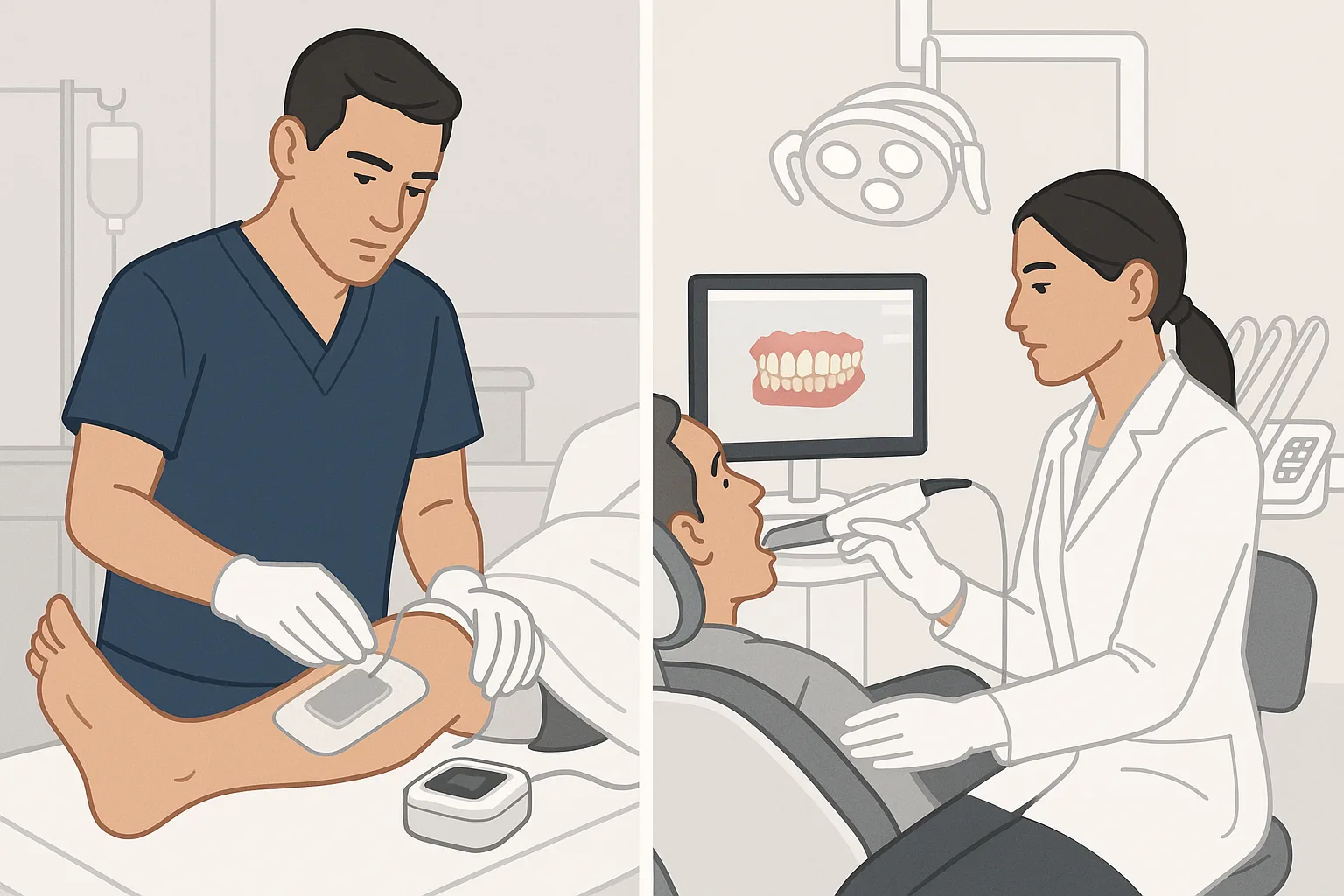
Specialized Care Devices in Wound Management & Dental: Where Clinical Workflow and Reimbursement Drive Buying Decisions
Wound management and dental device demand is shaped less by headline innovation and more by pragmatic adoption factors: evidence thresholds, workflow fit, infection prevention, and reimbursement economics. This article maps the technology landscape, key use cases, and commercial signals across these adjacent—but operationally distinct—specialized care segments.
R
ResearchX Editorial Team
Healthcare & Medical Devices Research
Specialized Care Devices in Wound Management & Dental: Where Clinical Workflow and Reimbursement Drive Buying Decisions content
Executive overview
“Specialized care” devices in wound management and dental span a wide range of products—advanced dressings, negative pressure wound therapy (NPWT) systems, debridement and cleansing tools, compression solutions, and in dentistry, implant systems, imaging, restorative materials, endodontic/periodontal instruments, and infection-control consumables. Despite serving different care pathways, both segments are heavily influenced by repeatable workflows (clinic, outpatient, home) and by the purchaser’s need to balance clinical outcomes with cost-to-treat and staff time.
What is changing is the center of gravity for differentiation. In wound care, adoption increasingly hinges on protocols that standardize assessment, reduce complications, and support site-of-care shifts (including home health and long-term care). In dental, digitization of diagnosis and restorative workflows (digital imaging, CAD/CAM, guided surgery) is reshaping purchasing decisions toward integrated ecosystems and service models. Across both, infection prevention, supply continuity, and documentation requirements are persistent decision drivers rather than “nice-to-haves.”
The most important market signals are practical: movement toward integrated platforms (devices + consumables + software), increased scrutiny of evidence and appropriate use (to avoid misuse and overutilization), and steady demand for products that reduce variability in outcomes. Vendors that can prove real-world workflow value—fewer visits, faster chairside steps, fewer complications, clearer documentation—tend to win share even when core technologies are mature.
Key Market Signal
In wound and dental segments alike, procurement is increasingly “system-level”: buyers evaluate product performance together with training burden, documentation, infection-control protocols, and supply reliability—not device specs in isolation.
Scope: what sits inside wound management vs. dental devices
Wound management is typically organized around assessment, bed preparation, infection management, moisture balance, and offloading/compression—plus enabling technologies such as NPWT and adjunctive therapies. Care settings range from acute care and outpatient wound centers to home health and long-term care, which creates heterogeneous requirements for portability, ease of use, and supply logistics.
Dental devices encompass diagnostics (intraoral imaging, radiography), treatment (handpieces, endodontic motors, periodontal scalers), restorative workflows (impressions, CAD/CAM milling/printing, materials), implantology (implants, abutments, guided surgery kits), and infection control. Dental purchasing often occurs at the practice or dental service organization (DSO) level, with decision criteria emphasizing chair-time efficiency, integration with practice management systems, and predictable consumable costs.
How buying criteria differ across the two segments
How buying criteria differ across the two segments
Dimension
Wound management devices
Dental devices
Primary success metric
Cost-to-treat and complication avoidance over an episode of care
Chairside efficiency, case acceptance, and predictable procedural outcomes
Typical care setting mix
Hospital, outpatient wound clinic, home health, long-term care
Dental office, group practice/DSO, ambulatory surgical settings for complex cases
Core workflow constraint
Documentation, dressing change cadence, staff time, coordination across sites of care
Throughput per operatory, imaging-to-restoration workflow, inventory management
Common procurement friction
Coverage rules, appropriate use, training across multiple caregiver types
Capital equipment ROI, ecosystem lock-in, service/support responsiveness
Consumable intensity
High (dressings, canisters, tubing, compression wraps)
High (restorative materials, burs, endo files, disposables)
Technology landscape: key product families and where innovation is happening
Wound management: from products to protocols
Many foundational wound products are mature, so innovation tends to be incremental and protocol-oriented—aimed at reducing variation in use and minimizing downstream complications. Differentiation is often about wear time, exudate handling, conformability, ease of application, and compatibility with infection-control practices. NPWT remains a major modality where portability, single-use/disposable options, alarm management, and training simplicity can influence adoption, especially outside the hospital.
Adjunctive tools—irrigation/cleansing, debridement instruments, offloading devices, and compression systems—compete on clinician preference and standardization potential. Digital documentation tools and connected care pathways are increasingly discussed, but their adoption depends on integration into existing electronic health record (EHR) workflows and reimbursement documentation needs rather than novelty.
Dental: digitization and platform integration
Dental technology evolution is strongly shaped by digital workflows: imaging, scanning, planning, and fabrication. Practices evaluating intraoral scanners, CAD/CAM systems, and related software increasingly seek end-to-end interoperability—or accept intentional “walled gardens” when the service model and reliability outweigh flexibility. In implantology, guided surgery planning and instrument kits can reduce variability but require training and consistent imaging and planning inputs.
Restorative and endodontic segments continue to evolve through materials science (handling characteristics, curing behaviors, strength and esthetics) and instrumentation ergonomics. However, commercial differentiation is frequently about total workflow time, remakes/adjustments, and support infrastructure (training, service, and consumables availability) rather than headline technical specs.
Adoption drivers: what moves budgets and changes standard of care
Shift to outpatient and home-based care (wound care in particular), favoring portable systems and simplified protocols
Pressure to reduce complications and re-treatments, increasing interest in standardized pathways and products with consistent performance
Infection prevention and cross-contamination control, driving single-use/disposable trends where clinically and economically justified
Staffing constraints and skill mix changes, making ease-of-use and training time major adoption levers
Growing value of documentation (medical necessity, wound progression, procedure notes), especially where reimbursement and audits are material
Digitized dental workflows that compress multi-visit procedures and improve predictability, supporting capital equipment purchasing when utilization is sufficient
In both segments, adoption is often less about a “better device” and more about reducing friction: fewer steps, fewer product changes, clearer indications, and fewer exceptions that require expert intervention. Vendors that provide practical implementation support—clinical education, protocol templates, and compatible supply chains—can be advantaged, but only if they avoid adding documentation or administrative burden.
Market challenges and restraints
Evidence and appropriate-use scrutiny: variability in patient factors and wound etiologies complicates direct product-to-outcome attribution
Reimbursement and coverage complexity in wound care, where documentation and coding expectations can constrain utilization
Procurement fragmentation: multiple stakeholders (clinicians, supply chain, administrators) with different success metrics
High consumable dependence and supply risk: backorders or substitutions can disrupt protocols and outcomes
Integration barriers for digital tools (EHR interfaces, cybersecurity reviews, workflow change management)
Capital equipment ROI uncertainty in dental when case mix or utilization is volatile
A recurring commercial issue is that “clinical value” and “budget impact” are evaluated on different timelines. Wound care products may prevent costly complications, but savings may accrue outside the department paying for the product. In dental, the practice may bear capital costs immediately while benefits arrive only if scheduling, marketing, and clinician adoption produce sustained throughput.
Clinical and operational use cases that shape purchasing
Wound management: chronic, complex, and high-variance pathways
Common high-focus use cases include chronic wounds (e.g., venous leg ulcers, diabetic foot ulcers, pressure injuries) and complex surgical wounds. Buyers weigh products based on how reliably they support core wound-care goals—managing exudate, supporting granulation, reducing maceration, and enabling consistent dressing changes—while minimizing unplanned visits and escalation.
Site-of-care matters. A therapy that works well in a specialized wound clinic may fail operationally in home health if it requires frequent troubleshooting, complex application, or supply logistics that are hard to sustain. As a result, portability, patient/caregiver adherence burden, and clear escalation pathways are often decisive.
Dental: productivity, predictability, and patient experience
Dental device selection is often anchored to throughput and predictability: imaging that supports diagnosis and case acceptance, scanning and planning that reduce remakes, and instruments that shorten procedure time. In restorative workflows, practices evaluate whether chairside fabrication meaningfully reduces visits without increasing rework or clinical risk.
For implantology, guided surgery and planning tools can standardize outcomes, but they introduce dependencies—imaging quality, planning expertise, and the reliability of the physical-to-digital transfer (guides, drills, sleeves). Practices and DSOs tend to prefer solutions that minimize vendor-to-vendor handoffs and provide clear training pathways.
Regional perspective: why adoption patterns vary without a single global playbook
Adoption patterns for wound and dental devices vary by payment models, site-of-care infrastructure, and workforce composition. Markets with stronger home health capacity may prioritize portable wound therapies and standardized home protocols, while markets with centralized hospital-based wound services may emphasize inpatient efficiency and formulary simplification.
In dentistry, practice structure matters: fragmented solo practices often buy incrementally and prioritize versatility and service responsiveness, while DSOs and group practices can standardize platforms across locations, negotiate bundled pricing, and enforce protocol-driven utilization. Regulatory and procurement processes also influence the pace of adopting connected and software-enabled tools, particularly where cybersecurity assessments are stringent.
Competitive landscape: what “winning” looks like in these segments
Both wound management and dental are characterized by a mix of diversified medtech companies, focused specialists, and a large ecosystem of distributors and private-label offerings (especially for commodity consumables). Because many products are clinically substitutable within categories, differentiation frequently comes from breadth of portfolio, training infrastructure, customer support, and supply reliability rather than raw performance claims.
In wound care, portfolio breadth can matter because protocols often require a consistent set of products across wound types and exudate levels, plus adjunctive modalities like NPWT. In dental, ecosystem strategy is often decisive: imaging + scanning + planning + fabrication + materials can be bundled into a cohesive workflow, which may increase switching costs but can also reduce integration headaches for the practice.
Common competitive strategies and their commercial implications
Common competitive strategies and their commercial implications
Strategy
How it shows up
Implication for buyers
Platform bundling
Device + consumables + software + service sold as a workflow
Potentially lower integration risk; higher vendor dependence and switching cost
Standardization programs
Training, protocols, and utilization management support
Can reduce variation; may require tighter governance and compliance monitoring
Consumables-led model
Aggressive placement of capital equipment tied to ongoing materials/consumables
Buyer must validate long-term total cost and supply continuity
Distributor leverage
Availability, logistics, and private-label alternatives
Convenience and pricing pressure; clinical preference may be harder to maintain across sites
Evidence positioning
Clinical dossiers, real-world use cases, economic arguments
Useful for committees; must be assessed for applicability to local workflows
Strategic implications for stakeholders
For manufacturers
Design for the care setting, not just the indication: home use constraints (training, alarms, portability) and dental operatory constraints (speed, sterilization, ergonomics) should shape product requirements
Invest in implementation assets (training pathways, protocols, documentation templates) that reduce adoption friction without adding administrative load
Prioritize interoperability where it lowers buyer burden (imaging/scanning software compatibility; wound documentation that aligns with existing EHR workflows)
Build resilient consumables supply strategies; substitutions can silently degrade outcomes and clinician trust
Prepare evidence and health-economic narratives cautiously: buyers increasingly demand context-specific proof tied to measurable workflow outcomes
For providers, DSOs, and procurement teams
Evaluate total workflow cost (staff time, visit frequency, rework/remakes, complications) rather than unit price alone
Standardize where it reduces variation, but preserve clinician choice where patient factors or technique sensitivity materially affect outcomes
Define documentation and audit-readiness requirements upfront, especially in wound care, to avoid downstream denials or rework
Assess vendor service levels (training, turnaround, field support) as a core part of the product, particularly for digital dental systems and NPWT
For investors and market strategists
Watch for consolidation around platforms that combine hardware, consumables, and software, especially where integration pain is a barrier
Expect growth opportunities to cluster in workflow-enabling solutions (connectivity, documentation, automation) rather than purely novel modalities in mature categories
Scrutinize business models reliant on consumables pull-through for exposure to supply disruptions and pricing pressure
Track regulatory and cybersecurity expectations for connected devices and software-enabled dental/wound systems as potential time-to-market determinants
Future outlook: likely directions over the next planning cycle
In wound management, the near-term trajectory is likely to emphasize standardization, site-of-care optimization, and tools that make wound assessment and documentation more consistent across clinicians. Portable and simplified NPWT and adjacent modalities may see increased use where home health capacity and payment models support them, while hospital systems may focus on formulary rationalization and reducing unwarranted variation.
In dental, continued digitization is likely to deepen platform competition: integrated imaging-to-restoration workflows, improved planning tools, and more predictable material and manufacturing processes. Practices will increasingly weigh technology purchases against staffing realities and scheduling utilization, favoring solutions that shorten procedures and reduce remakes without increasing training burden.
Across both segments, “connected” capabilities will expand cautiously. Buyers tend to adopt connectivity when it demonstrably reduces documentation time, improves coordination, or supports audit readiness—rather than simply offering dashboards. Vendors that can quantify operational impact in real clinical settings are more likely to sustain adoption as budgets remain disciplined.
Frequently Asked Questions
Wound management commonly includes advanced dressings and wound contact layers, NPWT systems, cleansing/irrigation and debridement tools, compression and offloading solutions, and supporting supplies needed to manage exudate, protect skin, and standardize dressing changes across settings.
Wound care purchasing tends to focus on episode-of-care outcomes such as complication avoidance, dressing-change cadence, and documentation requirements across sites of care. Dental purchasing more often emphasizes operatory throughput, integration across digital workflows (imaging/scanning/planning/fabrication), service support, and the predictability of restorative and implant procedures.
Wound care often requires consistent assessment and tracking over time, and many buyers need documentation that supports medical necessity and appropriate use. Tools and protocols that reduce documentation friction and improve consistency can be as influential as incremental product performance gains.
Digital dental workflows span multiple steps—diagnosis, scanning, planning, and fabrication—so practices and DSOs often prefer integrated ecosystems to reduce integration risk and remakes. Bundled service and support can be commercially compelling when it improves reliability and reduces training overhead.
Adoption is frequently limited by workflow change management, interoperability with existing systems (such as EHRs or practice management software), cybersecurity and IT review requirements, and uncertainty that connectivity will reduce staff time rather than add tasks.
Therapies that perform well in specialized clinics may be harder to sustain in home health or long-term care if they require complex application, frequent troubleshooting, or unreliable supply. Portability, ease of training, and adherence burden become decisive outside the hospital.
Key factors include staff time and training burden, visit frequency or chairside time, complication or rework risk, consumables continuity, service responsiveness, and how well products fit standardized protocols and documentation requirements.
MedInsight (ResearchX) announced new research coverage focused on oncology radiotherapy systems, targeted therapy delivery technologies, and the clinical and operational ecosystems that support precision cancer care. The coverage evaluates technology roadmaps, procurement considerations, and adoption drivers across major care settings.
MedInsight (ResearchX) has published new research coverage focused on surgical robotics, orthopedic implants, and enabling technologies shaping procedure workflows, procurement decisions, and competitive positioning. The coverage maps technology segmentation, adoption pathways, and risk factors across hospital and ASC environments.
MedInsight (ResearchX) has launched expanded research coverage focused on cardiovascular and endovascular medical devices, assessing technology trends, clinical adoption dynamics, and procurement and regulatory considerations shaping the category.
Bioresorbable vascular scaffolds (BVS) are drug-eluting coronary and peripheral implants that hold a vessel open, deliver an antiproliferative drug, then resorb so no permanent metal cage is left behind. The category was reset when Abbott withdrew Absorb GT1 after the FDA reported a higher two-year major adverse cardiac event rate than a metallic drug-eluting stent, and has since reformed around thin-strut polymer platforms, resorbable magnesium alloys and an entirely new…
The 3D-printed custom cranio-maxillofacial implants market covers patient-specific implants designed from individual anatomy and produced through additive manufacturing workflows for cranial and maxillofacial reconstruction. FDA recognizes 3D printing as a route for patient-specific medical devices, including cranial implants. A reliable standalone published market-size estimate for this exact niche was not identified, so the broader 3D Printed Implants Market is used as a quantitative benchmark.
CAGR
+18.22%
Forecast period
2026-2036
Need a Market View Built for Your Decision?
Get custom research on any market in the healthcare ecosystem, tailored to your business question. An analyst will scope the work, agree the method with you and deliver a model you can interrogate.
 Newsletter