
MedInsightHealthcare Market Intelligence
Bioresorbable Vascular Scaffolds Market

Bioresorbable Vascular Scaffolds Market Size, Share & Forecast 2026–2036

Key Market Insight

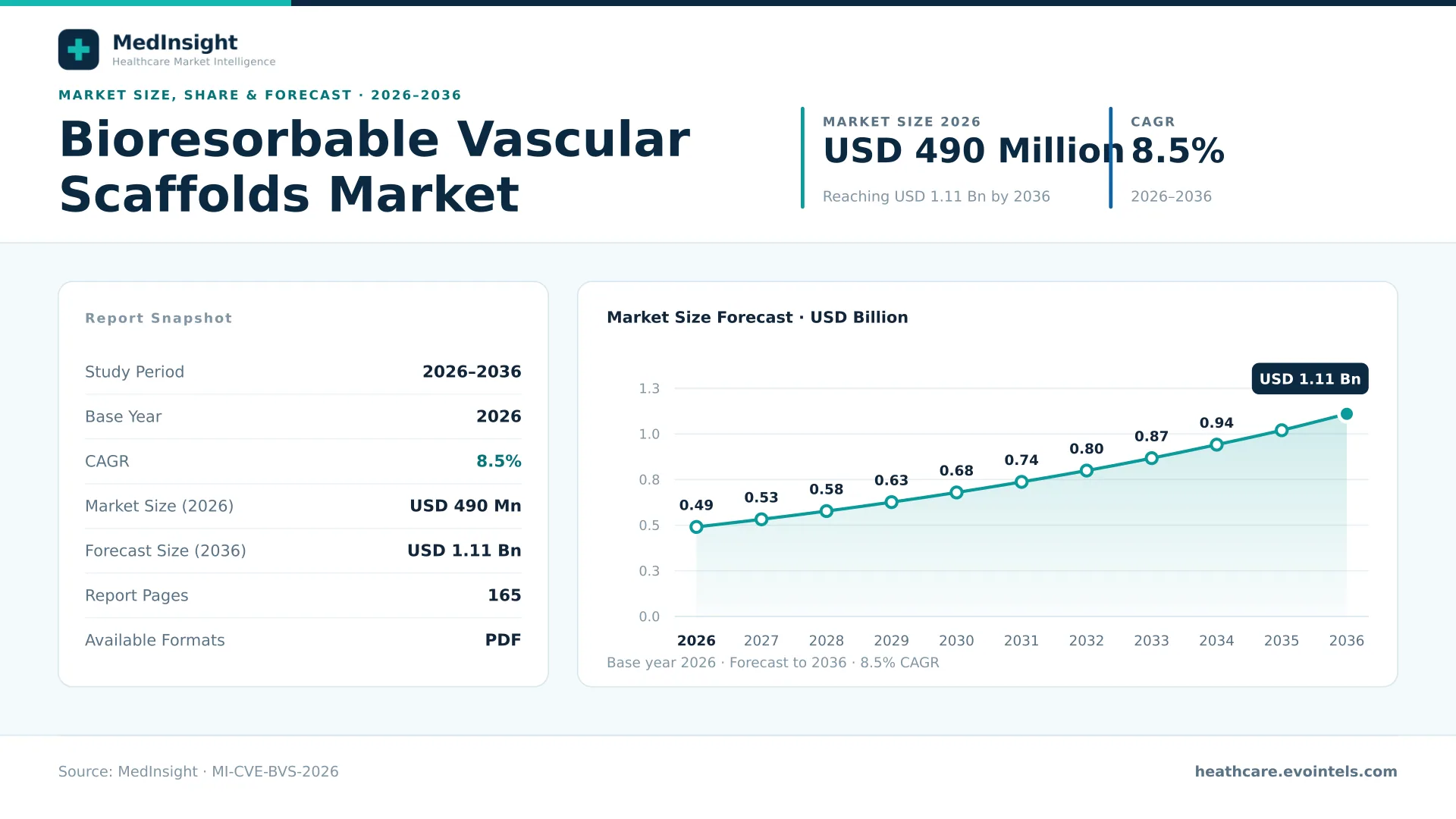
The Bioresorbable Vascular Scaffolds Market was valued at USD 490 Million in 2026 and is projected to reach USD 1.11 Billion by 2036, expanding at a CAGR of 8.5% during the forecast period.

  • Base Year 2026
  • Forecast 2026–2036
  • 5 Regions
  • 165 Pages

Market Size (2026)

USD 490 Million

CAGR

8.5%

Forecast Value (2036)

USD 1.11 Billion

Bioresorbable Vascular Scaffolds Market

8.5%CAGR

Bioresorbable Vascular Scaffolds Market report contents

Report Scope

Coverage, study period and deliverables

Bioresorbable Vascular Scaffolds Market report scope
Study Period2026–2036
Historical Period2019–2025
Market Size (2026)USD 490 Million
Forecast Value (2036)USD 1.11 Billion
CAGR8.5%
Largest MarketNorth America
Fastest Growing MarketAsia Pacific
Regions Covered5
Segments4
Companies Profiled6
Report Pages165
FormatPDF

Market Overview

2026 baseline and 2026–2036 forecast

A bioresorbable vascular scaffold performs the mechanical job of a stent for the months in which a treated artery needs scaffolding, elutes an antiproliferative drug across the same window, and then degrades into metabolites the body clears. The clinical argument is that a permanent metal cage contributes nothing after healing and costs something thereafter — it constrains vasomotion, complicates future surgical or percutaneous access, and leaves a lifelong substrate for neoatherosclerosis and very late thrombosis. The commercial argument has always depended on whether that long-term benefit can be delivered without a short-term safety penalty. For most of the last decade it could not. Abbott's Absorb GT1, the first FDA-approved coronary BVS, was withdrawn from commercial sale after the agency notified clinicians in March 2017 that two-year ABSORB III data showed an 11% major adverse cardiac event rate against 7.9% for the metallic XIENCE drug-eluting stent, a statistically significant difference driven substantially by scaffold thrombosis during the resorption phase. The 2018 ESC/EACTS revascularisation guidelines subsequently assigned bioresorbable scaffolds a Class III recommendation outside clinical studies, and coronary BVS volumes in Europe and North America collapsed accordingly. Any honest reading of this market has to start from that reset rather than from an extrapolation of pre-2017 growth. What has changed since is engineering and indication. Strut thickness has fallen from the 150 µm of first-generation polymer devices to 100 µm in Meril's MeRes100 and Elixir's DESolve 100, and to 99–147 µm in Biotronik's third-generation magnesium DREAMS 3G/Freesolve platform. Resorption windows have compressed from three-plus years to roughly twelve months for magnesium. More consequentially, the category found an indication where the incumbent is not a good permanent stent but a bare balloon: infrapopliteal disease in chronic limb-threatening ischaemia. The LIFE-BTK randomised trial, published in the New England Journal of Medicine in October 2023, showed an everolimus-eluting resorbable scaffold superior to plain angioplasty on the primary efficacy endpoint and non-inferior on safety, and the FDA approval followed in April 2024. The addressable population is large and under-treated. The CDC estimates roughly 6.5 million US adults aged 40 and over have peripheral arterial disease, and cardiovascular disease accounted for an estimated 19.8 million deaths worldwide in 2022 — about 32% of all global deaths, per WHO. Chronic limb-threatening ischaemia represents the severe tail of that PAD population, with amputation and mortality rates that make even incremental patency gains clinically and economically significant. The near-term market is therefore best understood as two distinct businesses: a constrained, guideline-limited coronary segment concentrated in Asia, and a small but rapidly forming peripheral segment led by the United States.

Bioresorbable Vascular Scaffolds Market Size, CAGR and Forecast, 2026–2036

Report Description

What this report covers

Covers fully bioresorbable vascular scaffolds for coronary and peripheral arterial intervention, including poly-L-lactic acid (PLLA) platforms, resorbable magnesium alloy scaffolds and tyrosine-derived polycarbonate devices. Permanent metallic drug-eluting stents, drug-coated balloons and non-resorbable bioadaptor platforms are outside the scope.

Traces the category's collapse after the Absorb GT1 withdrawal and its reconstruction around thinner struts, faster resorption and a below-the-knee chronic limb-threatening ischaemia indication that no permanent stent had previously satisfied.

Quantifies the market across a 2019–2025 historical period, a 2026 base year and a 2026–2036 forecast, with segmentation by material, drug-elution technology, application and end user, and regional analysis across the five ResearchX regions.

Key Market Insights

Headline findings from the analysis

  1. 1The market's centre of gravity has shifted from coronary to peripheral intervention. Abbott's Esprit BTK, approved by the FDA on 26 April 2024, is a drug-eluting resorbable scaffold for infrapopliteal chronic limb-threatening ischaemia — an anatomy where permanent stents have historically performed poorly, so the scaffold competes against plain balloon angioplasty rather than against a metallic drug-eluting stent.
  2. 2Resorbable magnesium has become the credible metallic alternative to PLLA. Biotronik's third-generation Freesolve scaffold resorbs 99.3% of its magnesium by 12 months and reported a 2.6% target lesion failure rate at 12 months in BIOMAG-I, addressing the slow-resorption and thick-strut criticisms that undermined first-generation polymer devices.
  3. 3China has become a self-contained BVS market with its own approved platforms. NeoVas received NMPA approval in 2019 and Xinsorb in 2020, and MicroPort's Firesorb followed on 30 July 2024, giving Asia Pacific a domestic supply base independent of Western regulatory timing.
  4. 4Reimbursement, not just approval, is now moving. CMS set an Esprit BTK New Technology Add-on Payment maximum of USD 6,922.50 for Fiscal Year 2026 effective 1 October 2025, which materially changes hospital economics for a device class that had none.
  5. 5European coronary guidance remains the single largest brake on volume. Bioresorbable scaffolds carry a Class III (Level of Evidence C) recommendation in the 2018 ESC/EACTS myocardial revascularisation guidelines, meaning they are not recommended outside clinical studies — a position that still governs routine coronary practice.
  6. 6Clinical adoption is being narrowed deliberately rather than broadened. A 2026 expert consensus on infrapopliteal drug-eluting resorbable scaffolds found strong agreement only for vessels ≥3 mm, lesions ≤60 mm, adequate vessel preparation and high-volume centres, with no consensus on small vessels, long-segment disease or dialysis patients.

Market Dynamics

Drivers, restraints, opportunities and challenges shaping the market

Growth Drivers

  • A regulatory-validated below-the-knee indication. FDA approval of Esprit BTK in April 2024 created the first drug-eluting resorbable scaffold cleared for infrapopliteal chronic limb-threatening ischaemia, converting a research category into a reimbursable procedure in the largest single medtech market.
  • Reimbursement mechanics catching up with approval. CMS set an FY2026 New Technology Add-on Payment maximum of USD 6,922.50 for Esprit BTK effective 1 October 2025, and CMS issued New Technology ICD-10-PCS codes for everolimus-eluting resorbable scaffold implantation in below-the-knee arteries effective 1 October 2024 — both removing the cost barrier that suppresses novel-device adoption.
  • A very large and growing at-risk population. The CDC estimates approximately 6.5 million US adults aged 40 and over have peripheral arterial disease, and WHO attributes an estimated 19.8 million deaths in 2022 to cardiovascular disease, sustaining structural demand for both coronary and peripheral revascularisation.
  • Material and design maturity. Third-generation magnesium scaffolds now resorb 99.3% of their magnesium within 12 months with strut thicknesses of 99–147 µm, and thin-strut PLLA platforms such as MeRes100 have reported zero scaffold thrombosis with a 1.87% three-year MACE rate — directly addressing the failure mode that ended the first generation.
  • A domestic Chinese supply base with regulatory momentum. NeoVas (2019), Xinsorb (2020) and Firesorb (July 2024) all hold NMPA approval, letting China build coronary BVS volume on local platforms and local pricing without waiting on Western approvals.

Restraints

  • A standing Class III guideline recommendation in coronary intervention. The 2018 ESC/EACTS myocardial revascularisation guidelines assign bioresorbable scaffolds a Class III (Level of Evidence C) recommendation outside well-controlled clinical studies, and that position still governs routine European coronary practice — effectively capping the largest historical application.
  • The unresolved memory of Absorb. The FDA's March 2017 notification of an 11% versus 7.9% two-year MACE difference against a metallic drug-eluting stent, driven by scaffold thrombosis during resorption, shapes operator willingness to re-adopt the category regardless of newer device data.
  • No US coronary approval. Freesolve is explicitly not available for sale in the United States, and the NMPA-approved Chinese platforms are not FDA-cleared, so the world's largest coronary market has no commercially available bioresorbable coronary scaffold at all.
  • Procedural demands that limit the eligible operator base. Expert consensus for infrapopliteal scaffolds reaches strong agreement only where vessel preparation is adequate and treatment occurs in high-volume centres performing more than 30 cases per year with advanced imaging and surgical backup, which constrains diffusion into community practice.
  • Prolonged dual antiplatelet therapy requirements. Because the thrombotic risk window tracks the resorption window rather than ending at endothelialisation, antiplatelet duration is longer and less flexible than for metallic stents, which disqualifies patients likely to need therapy interruption.

Opportunities

  • Durability evidence in the peripheral indication. Two-year LIFE-BTK results extend the randomised comparison against angioplasty beyond the one-year primary endpoint; sustained separation is the single most valuable asset for expanding infrapopliteal scaffold use beyond early-adopter centres.
  • A second entrant in below-the-knee. Biotronik received FDA Breakthrough Device designation for the Freesolve BTK resorbable magnesium scaffold on 18 March 2024, and a magnesium alternative to a polymer scaffold would convert a single-product indication into a competitive category with the price and volume dynamics that follow.
  • Coronary rehabilitation through adequately powered randomised evidence. BIOMAG-II enrolled its first patient in May 2024 as an international randomised controlled trial of Freesolve against a contemporary drug-eluting stent across 21 countries with a 1,859-patient target — the scale required to revisit a Class III guideline position.
  • Alternative resorbable chemistries beyond PLLA and magnesium. Tyrosine-derived polycarbonate scaffolds have now reported 36-month European post-market data in below-the-knee disease, and iron-based platforms are in preclinical and early clinical development, widening the design space for radial strength at low strut thickness.

Challenges

  • Defining the eligible lesion without shrinking the market to nothing. Consensus support for infrapopliteal scaffolds is strong only for vessels ≥3 mm and lesions ≤60 mm, yet much real-world below-the-knee disease is smaller-calibre and longer — so the evidence-supported population is materially narrower than the diagnosed population.
  • Proving that faster resorption actually removes the thrombotic penalty. Magnesium resorbs within roughly 12 months versus three years for PLLA, but registry data for the earlier Magmaris platform in complex lesions still reported 2.0% scaffold thrombosis and 5.0% target lesion failure at one year, so shorter resorption is a plausible mechanism rather than a demonstrated fix.
  • Operator technique as a determinant of outcome. Scaffold results depend heavily on lesion preparation and accurate sizing, typically with intravascular imaging — a dependency that makes multi-centre results harder to reproduce and slows the transition from trial performance to routine performance.
  • Building a commercial case against cheap, entrenched alternatives. In coronary work the comparator is a low-cost, well-understood thin-strut metallic drug-eluting stent; in peripheral work it is balloon angioplasty. A resorbable scaffold has to justify a substantial per-case premium against both without long-term mortality or amputation-free-survival superiority yet established.

Key Trends

  • Strut thickness has converged on 100 µm and below as the design requirement rather than a differentiator, with MeRes100 and DESolve 100 at 100 µm and DREAMS 3G at 99–147 µm, against roughly 150 µm for first-generation Absorb.
  • Resorbable magnesium alloys are displacing PLLA as the premium coronary platform, trading polymer's radiolucency and slow degradation for metallic radial strength and a roughly 12-month resorption window.
  • Sirolimus has become the default elution chemistry across newer platforms — Freesolve, MeRes100, NeoVas, Xinsorb and Firesorb are all sirolimus-based — while everolimus remains the peripheral standard through Esprit BTK and novolimus persists in DESolve.
  • Regulatory divergence is hardening into distinct regional product portfolios: CE-marked magnesium and PLLA coronary devices in Europe, NMPA-approved domestic platforms in China, and a US market where the only approved resorbable scaffold is peripheral.
  • Evidence generation is shifting from single-arm first-in-human imaging studies toward large randomised trials against contemporary drug-eluting stents, reflecting that the category now has to overturn a guideline position rather than simply demonstrate feasibility.

Industry Developments

  1. 2017On 18 March 2017 the FDA issued a Letter to Health Care Providers reporting an 11% two-year major adverse cardiac event rate for Abbott's Absorb GT1 BVS against 7.9% for the metallic XIENCE drug-eluting stent; Abbott subsequently stopped commercial sales of Absorb.
  2. 2023The LIFE-BTK randomised controlled trial was published in the New England Journal of Medicine on 25 October 2023, showing an everolimus-eluting resorbable scaffold superior to balloon angioplasty on the primary efficacy endpoint and non-inferior on safety in 261 patients with infrapopliteal chronic limb-threatening ischaemia.
  3. 2024Biotronik announced CE approval and launch of Freesolve, its third-generation resorbable magnesium scaffold, on 13 February 2024, reporting 99.3% magnesium resorption and a 2.6% target lesion failure rate at 12 months in BIOMAG-I.
  4. 2024The FDA granted Breakthrough Device designation to Biotronik's Freesolve below-the-knee resorbable magnesium scaffold for chronic limb-threatening ischaemia on 18 March 2024.
  5. 2024The FDA approved Abbott's Esprit BTK Everolimus Eluting Resorbable Scaffold System under PMA P230036 on 26 April 2024, the first drug-eluting resorbable scaffold approved in the United States for infrapopliteal chronic limb-threatening ischaemia.
  6. 2024MicroPort Scientific received NMPA market approval for its Firesorb bioresorbable cardiac stent on 30 July 2024, citing a 3.5% three-year target lesion failure rate and a 0.32% thrombosis rate across the FUTURE-I, II and III studies.
  7. 2025CMS set a New Technology Add-on Payment maximum of USD 6,922.50 for the Esprit BTK System for Fiscal Year 2026, effective 1 October 2025, giving the device class its first dedicated incremental Medicare inpatient payment.

Segmentation Analysis

How the market breaks down across the dimensions covered

By Material

  • Poly-L-Lactic Acid (PLLA) Scaffolds: The original and still most widely approved backbone, used by Absorb, MeRes100, DESolve 100, NeoVas, Xinsorb and Firesorb. PLLA is radiolucent and degrades over roughly two to three years, which historically forced thicker struts to achieve adequate radial strength. Thin-strut generations at 100 µm have largely closed that gap and this remains the volume material, particularly in China.
  • Resorbable Magnesium Alloy Scaffolds: Metallic alloys such as Biotronik's BIOmag provide drug-eluting-stent-like radial support at 99–147 µm strut thickness with roughly 99.3% of magnesium resorbed by 12 months. The shorter resorption window directly targets the late scaffold thrombosis mechanism that ended the first polymer generation, making this the premium coronary platform in CE-accepting markets.
  • Tyrosine-Derived Polycarbonate Scaffolds: A polymer chemistry developed specifically for peripheral use, with radiopacity characteristics that ease deployment accuracy below the knee. European post-market below-the-knee experience now extends to 36 months, establishing it as a viable alternative chemistry in infrapopliteal disease rather than a coronary competitor.
  • Iron-Based and Other Emerging Chemistries: Iron bioresorbable scaffolds remain in preclinical and early clinical development, offering higher strength than magnesium at the cost of much slower degradation. These platforms currently generate no commercial revenue and are included because material innovation is the principal lever on the strut-thickness and resorption-rate trade-off that defines the category.

By Drug-Elution Technology

  • Sirolimus-Eluting Scaffolds: The dominant chemistry across newer platforms, used by Freesolve, MeRes100, NeoVas, Xinsorb and Firesorb. Sirolimus has the deepest safety record of any limus agent in coronary stenting and is typically delivered from a PDLLA or PLLA surface coating. Its prevalence reflects vendors minimising pharmacological novelty while the scaffold itself is the variable under scrutiny.
  • Everolimus-Eluting Scaffolds: The chemistry of both the withdrawn Absorb GT1 and the approved Esprit BTK, and therefore the only elution technology with FDA approval in this category. Everolimus carries the peripheral evidence base through LIFE-BTK, which makes it the reference chemistry for below-the-knee chronic limb-threatening ischaemia.
  • Novolimus-Eluting Scaffolds: Used by Elixir Medical's DESolve platform, which paired novolimus with a 100 µm strut profile and approximately one-year degradation. It remains a CE-marked European option and is significant mainly for having demonstrated that thin struts and fast resorption were achievable well before magnesium platforms arrived.
  • Non-Drug-Eluting Resorbable Scaffolds: Bare resorbable scaffolds without an antiproliferative coating are now essentially historical in coronary use, given restenosis rates that drug elution was introduced to control. They retain limited relevance in selected peripheral and paediatric applications where drug exposure is undesirable.

By Application

  • Coronary Artery Disease: Historically the entire market and still the larger installed application by procedure volume, concentrated in China and in selected European centres. Growth is capped by the 2018 ESC/EACTS Class III recommendation and by the absence of any FDA-approved coronary resorbable scaffold, so this segment grows with Chinese PCI volume rather than with global interventional cardiology.
  • Infrapopliteal / Below-the-Knee Peripheral Artery Disease: The fastest-growing application and the only one with a US approval, addressed by Esprit BTK for chronic limb-threatening ischaemia. Because the comparator here is balloon angioplasty rather than a well-performing permanent stent, the clinical bar is lower and the incremental benefit clearer, which is why this segment carries most of the forecast's growth.
  • Other Peripheral Vascular Applications: Includes above-the-knee femoropopliteal and selected visceral applications where resorbable scaffolding is under investigation but not approved. Vessel mobility and lesion length in these territories place demands on radial strength and fatigue resistance that current resorbable materials have not yet met at commercially acceptable strut thickness.

By End User

  • Hospitals and Tertiary Cardiac Centres: The primary setting and the one expert consensus favours, since infrapopliteal scaffold outcomes correlate with operator volume, intravascular imaging availability and on-site surgical backup. Consensus support is strongest for centres performing more than 30 such cases annually, which concentrates volume in large academic and tertiary institutions.
  • Ambulatory Surgical Centres and Office-Based Labs: A growing setting for peripheral intervention in the United States, and one where Medicare payment policy is now specifically relevant to resorbable scaffolds. Growth here depends on whether the imaging and vessel-preparation requirements that support good outcomes can be met outside a hospital setting.
  • Specialty Cardiovascular and Limb-Preservation Clinics: Multidisciplinary clinics managing chronic limb-threatening ischaemia are becoming referral gatekeepers for scaffold-eligible patients, since identifying the ≥3 mm, ≤60 mm lesions the evidence supports requires systematic assessment rather than opportunistic case selection.

Regional Analysis

Performance across the geographies this report covers

Regional demand for bioresorbable vascular scaffolds is unusually decoupled from general interventional cardiology volume, because approval status differs by indication as well as by geography. North America is the largest market and is effectively a single-indication market. There is no FDA-approved bioresorbable coronary scaffold following the Absorb GT1 withdrawal, so essentially all US revenue derives from Esprit BTK in infrapopliteal chronic limb-threatening ischaemia. That narrow base is offset by reimbursement depth: an FY2026 NTAP maximum of USD 6,922.50 effective 1 October 2025, and dedicated New Technology ICD-10-PCS codes effective 1 October 2024. Roughly 6.5 million US adults aged 40 and over have peripheral arterial disease, of whom the CLTI subset is the addressable population. Europe is the opposite case — coronary devices are commercially available but guideline-constrained. Freesolve, Magmaris, DESolve 100 and MeRes100 all hold CE marking, yet the 2018 ESC/EACTS Class III recommendation confines routine coronary use to clinical studies, so European volume concentrates in high-volume academic centres and registry participation rather than general practice. European post-market below-the-knee experience, including 36-month MOTIV data, is building a second European use case. Asia Pacific is the fastest-growing region and the only one with a self-sufficient coronary platform base. NeoVas (NMPA 2019), Xinsorb (NMPA 2020) and Firesorb (NMPA July 2024) are domestically developed and approved, and India contributes both a manufacturing base and a domestic market through Meril's MeRes100, which holds CE and Indian regulatory approval and was evaluated across 13 Indian sites in MeRes-1. Volume growth here is driven by rising PCI rates and centralised procurement rather than by Western guideline positions. Latin America and Middle East & Africa remain small, import-dependent and concentrated in a handful of tertiary centres in Brazil, Mexico, Saudi Arabia, the UAE and South Africa. Adoption in both regions generally follows CE marking rather than independent regulatory review, and out-of-pocket or limited insurance funding keeps premium-priced resorbable devices confined to private and specialist practice.

  • North America

    Largest market

    The largest market by value and effectively a single-indication one. With no FDA-approved bioresorbable coronary scaffold since the Absorb GT1 withdrawal, essentially all US revenue comes from Esprit BTK in infrapopliteal chronic limb-threatening ischaemia, approved 26 April 2024. Reimbursement depth compensates for the narrow indication: CMS issued dedicated New Technology ICD-10-PCS codes effective 1 October 2024 and set an FY2026 NTAP maximum of USD 6,922.50 effective 1 October 2025. With roughly 6.5 million US adults aged 40 and over carrying a PAD diagnosis, the CLTI subset alone supports a durable commercial base.

  • Europe

    Permissive on market access, restrictive on clinical recommendation. Freesolve, Magmaris, DESolve 100 and MeRes100 all hold CE marking, but the 2018 ESC/EACTS Class III (Level of Evidence C) recommendation confines routine coronary use to well-controlled clinical studies, so volume concentrates in high-volume academic centres and registry participation. Europe is nonetheless where the category's decisive coronary evidence is being generated, through BIOMAG-II and multi-country magnesium registries, and European post-market below-the-knee data now extends to 36 months for alternative polymer chemistries.

  • Asia Pacific

    Fastest growing

    The fastest-growing region and the only one with a self-sufficient coronary platform base. China approved NeoVas in 2019, Xinsorb in 2020 and MicroPort's Firesorb on 30 July 2024 through the NMPA, which required three-year clinical follow-up for the PLA-based devices — a longer evidentiary window than first-generation European devices faced. India contributes both manufacturing and domestic demand through Meril's MeRes100, evaluated across 13 Indian sites in MeRes-1 and holding CE and Indian regulatory approval. Growth here tracks rising PCI volumes and centralised procurement rather than Western guideline positions.

  • Latin America

    A small, import-dependent market concentrated in tertiary centres in Brazil, Mexico, Argentina and Colombia. Device availability generally follows CE marking rather than independent regulatory assessment, so the regional portfolio mirrors Europe's with a lag. Premium pricing relative to metallic drug-eluting stents keeps resorbable scaffolds largely within private hospital networks and specialist practice, and public systems have limited exposure to the category.

  • Middle East & Africa

    The smallest regional market, with meaningful activity confined to well-funded tertiary centres in Saudi Arabia, the UAE, Israel, Turkey and South Africa. Adoption follows CE marking and imported clinical practice, and the diabetic PAD burden in several Gulf states makes below-the-knee limb preservation a clinically relevant use case as scaffolds become available outside the United States. Across most of Sub-Saharan Africa, interventional capacity rather than device availability is the binding constraint.

Competitive Landscape

Market structure and the positioning of leading suppliers

The competitive structure is defined by which regulator each vendor has satisfied, not by conventional share of a single addressable market. Abbott holds the strongest position in the peripheral segment and, by a wide margin, the most valuable regulatory asset: Esprit BTK is the only FDA-approved drug-eluting resorbable scaffold in the United States. Abbott also carries the category's institutional memory, having developed and withdrawn Absorb GT1, and its peripheral programme is structured around randomised evidence (LIFE-BTK) and a formal post-approval study rather than registry data alone. Biotronik is the strongest coronary challenger and the only vendor credibly pursuing both segments with a single materials platform. Freesolve carries CE approval on the BIOmag magnesium alloy with Orsiro-derived sirolimus coating, and the Freesolve BTK variant holds FDA Breakthrough Device designation. BIOMAG-II, a 1,859-patient randomised trial against a contemporary drug-eluting stent across 21 countries, is the category's most consequential open question. The Chinese vendors — MicroPort Scientific with Firesorb and Lepu Medical with NeoVas — compete primarily inside China, where NMPA approval and domestic procurement give them a protected base. MicroPort's Firesorb approval in July 2024 is the most recent NMPA entry and is supported by the FUTURE-I, II and III programme, with a reported 3.5% three-year target lesion failure rate. Meril Life Sciences and Elixir Medical occupy the thin-strut PLLA niche. MeRes100 was among the first 100 µm sirolimus-eluting bioresorbable scaffolds to obtain CE marking and reports long-term MeRes-1 follow-up with zero scaffold thrombosis; Elixir's DESolve 100 established the 100 µm novolimus-eluting design in Europe, though Elixir's more recent commercial emphasis has moved toward non-resorbable bioadaptor technology. Neither holds US approval in this category.

Major Players

  • Abbott
  • Biotronik
  • MicroPort Scientific
  • Meril Life Sciences
  • Elixir Medical
  • Lepu Medical Technology

Company Profiles

Companies analysed in the full deliverable

Six vendors account for substantially all commercially approved bioresorbable vascular scaffold activity worldwide. Their positions differ less by scale than by which regulatory jurisdiction and which anatomy they have cleared, and the structured company list accompanying this report gives each vendor's platform, material chemistry and approval status. Abbott and Biotronik are the two vendors with programmes in both coronary and peripheral anatomy; MicroPort Scientific and Lepu Medical are China-centred coronary specialists operating under NMPA approval; Meril Life Sciences and Elixir Medical hold CE-marked thin-strut PLLA coronary platforms without US approval in this category. No vendor in this set currently sells a bioresorbable coronary scaffold in the United States.

  • Abbott

    Holds the only FDA-approved drug-eluting resorbable scaffold in the United States, the Esprit BTK Everolimus Eluting Resorbable Scaffold System, approved under PMA P230036 on 26 April 2024 for infrapopliteal chronic limb-threatening ischaemia and supported by the randomised LIFE-BTK trial. Abbott also developed Absorb GT1, the first FDA-approved coronary bioresorbable scaffold, which was the subject of a March 2017 FDA Letter to Health Care Providers and is no longer marketed. The company runs a formal Esprit BTK post-approval study.

  • Biotronik

    The leading developer of resorbable magnesium scaffolds, with the Magmaris (DREAMS 2G) and third-generation Freesolve (DREAMS 3G) platforms. Freesolve announced CE approval and launch on 13 February 2024, built on the proprietary BIOmag magnesium alloy with Orsiro-derived sirolimus coating, reporting 99.3% magnesium resorption and 2.6% target lesion failure at 12 months in BIOMAG-I. The Freesolve BTK variant received FDA Breakthrough Device designation on 18 March 2024, and BIOMAG-II is enrolling 1,859 patients across 21 countries against a contemporary drug-eluting stent. Freesolve is not available for sale in the US.

  • MicroPort Scientific

    Received NMPA market approval for its Firesorb bioresorbable cardiac stent on 30 July 2024 through its Shanghai MicroPort Medical subsidiary, making it the most recent domestically approved Chinese coronary platform. The company reports a 3.5% three-year target lesion failure rate and a 0.32% thrombosis rate across the FUTURE-I, FUTURE-II and FUTURE-III study programme, with full degradation stated at three years.

  • Meril Life Sciences

    Developer of MeRes100, a sirolimus-eluting PLLA bioresorbable vascular scaffold with a 100 µm strut thickness, holding both CE marking and Indian regulatory approval. The MeRes-1 first-in-human trial enrolled 108 patients across 13 Indian sites and reported zero scaffold thrombosis with a 1.87% MACE rate at three years, alongside 99.24% strut coverage and 0.24 mm late lumen loss at two years.

  • Elixir Medical

    Received CE Mark approval for the DESolve 100 novolimus-eluting bioresorbable coronary scaffold, a 100 µm strut platform designed to degrade within approximately one year — among the first devices to combine thin struts with fast resorption in the polymer category. Elixir's more recent commercial emphasis has moved toward non-resorbable bioadaptor technology, and the company holds no US approval in the resorbable scaffold category.

  • Lepu Medical Technology

    Developer of NeoVas, a sirolimus-eluting PLLA-based bioresorbable coronary scaffold with a poly(D,L-lactide) coating and approximately 170 µm strut thickness, approved by China's NMPA in 2019 after the regulator required three-year clinical follow-up outcomes. NeoVas was evaluated through a first-in-human study and a randomised controlled trial against a metallic everolimus-eluting stent, with five-year outcomes since reported.

Regulatory Landscape

Approval pathways and compliance considerations

Three regulatory facts define this market. First, the United States has one approved resorbable scaffold and it is peripheral. The FDA approved Esprit BTK under PMA P230036 on 26 April 2024 for chronic limb-threatening ischaemia in the lower leg, on the basis of a 261-patient study in which the effectiveness endpoint — freedom from above-ankle amputation, additional procedure, vessel occlusion and binary restenosis at one year — was met in 75% of scaffold patients against 44% of controls, with roughly 97% free of major safety events through six months. Abbott's Absorb GT1 coronary scaffold, approved in July 2016, was the subject of a March 2017 FDA Letter to Health Care Providers and is no longer marketed. Second, Europe is permissive on market access and restrictive on clinical recommendation. CE marking is held by Freesolve (announced 13 February 2024), Magmaris, DESolve 100 and MeRes100, but the 2018 ESC/EACTS myocardial revascularisation guidelines carry a Class III (Level of Evidence C) recommendation against bioresorbable scaffold use outside well-controlled clinical studies, and that recommendation remains in force. Market authorisation and guideline endorsement point in opposite directions, and the guideline is what governs routine coronary practice. Third, China operates an independent approval track that has produced three domestic coronary platforms: NeoVas (2019), Xinsorb (2020) and Firesorb (30 July 2024). NMPA required three-year clinical follow-up before approving the PLA-based devices, a materially longer evidentiary window than the CE pathway applied to first-generation European devices. Reimbursement has moved separately from approval and now favours the peripheral indication in the United States: CMS issued New Technology ICD-10-PCS codes for below-the-knee everolimus-eluting resorbable scaffold implantation effective 1 October 2024, and set an Esprit BTK New Technology Add-on Payment maximum of USD 6,922.50 for Fiscal Year 2026 effective 1 October 2025.

Future Outlook

Where the market is expected to go next

Through 2036 the market's trajectory depends on two independent questions, and they are unlikely to resolve at the same time. The peripheral question is whether below-the-knee scaffold benefit persists. One-year LIFE-BTK superiority over angioplasty is established and two-year data are now reported; the commercially decisive point is whether separation holds through the full resorption window and translates into amputation-free survival rather than patency alone. If it does, and if Biotronik's Freesolve BTK converts its March 2024 Breakthrough Device designation into approval, the infrapopliteal segment becomes a genuinely competitive market. This is the higher-probability growth path and the one underwriting the faster-growing peripheral share of the forecast. The coronary question is whether a Class III guideline recommendation can be reversed. Only an adequately powered randomised trial against a contemporary drug-eluting stent can do that, and BIOMAG-II — 1,859 patients across 21 countries — is the only such trial running. A positive result would reopen the European and, eventually, the US coronary market; a neutral or negative result would likely confine coronary BVS permanently to China and to selected European centres. Given enrolment beginning in May 2024 and the follow-up such a trial requires, a guideline-relevant readout falls in the second half of this forecast period, which is why the modelled compound growth rate stays in single digits rather than assuming a coronary recovery. Clinical practice is meanwhile narrowing rather than broadening the indication. The 2026 expert consensus on infrapopliteal scaffolds found strong agreement only for vessels ≥3 mm, lesions ≤60 mm, adequate vessel preparation and high-volume centres. A disciplined, evidence-bounded indication is the more durable outcome for this category than rapid diffusion — the first generation of this market was lost precisely by treating patients the evidence did not support.

Research Methodology

How these estimates were built and reconciled

Qualitative findings in this report — approvals, indications, device specifications, trial results and reimbursement determinations — are drawn from primary sources and cited at the section level: FDA device approval and safety communications, WHO and CDC epidemiology, manufacturer regulatory and product disclosures from Abbott, Biotronik, MicroPort and Elixir, and peer-reviewed publications in the New England Journal of Medicine, EuroIntervention, the Journal of the Society for Cardiovascular Angiography & Interventions and Frontiers in Cardiovascular Medicine. Market sizing is explicitly weaker than the qualitative evidence, and the distinction matters. No government, regulatory, academic or manufacturer source publishes a total market size for bioresorbable vascular scaffolds. Published third-party estimates exist but diverge severely — base-year values spanning roughly USD 290 million to USD 660 million and compound annual growth rates from about 8% to 14% appear across commercial publishers for overlapping periods. The USD 490 Million 2026 base-year value used here is a ResearchX reconciliation of the two most closely aligned published 2026 estimates and is NOT a figure published by any single source. It should be read as an order-of-magnitude anchor, not a measurement. The 8.5% CAGR is likewise ResearchX-derived, reconciled from published rates of 8.45% (2026–2031) and 8.6% (2026–2033). Annual forecast values for 2027 through 2036 were calculated by compounding the 2026 anchor at that rate. These calculated values are model-derived and must not be interpreted as individually published market estimates. Forecast figures are rounded to whole millions through 2034 and to two decimal places in billions thereafter, which reflects the precision the underlying evidence supports. Regional ranking follows the regulatory and reimbursement structure documented in this report rather than a published revenue split: North America is identified as largest because it is the only market with an approved, separately reimbursed resorbable scaffold indication, and Asia Pacific as fastest-growing because it is the only region adding domestically approved coronary platforms. Segment-level percentage shares are not published in this report because no source of adequate quality supports them.

  1. 01

    Primary research

    Interviews with manufacturers, providers and payers.

  2. 02

    Secondary research

    Regulatory filings, procurement records and vendor reporting.

  3. 03

    Model reconciliation

    Bottom-up sizing triangulated against reported revenue.

Frequently Asked Questions

Common questions about this report

This report uses a 2026 base-year value of USD 490 Million. That figure is a ResearchX reconciliation of divergent published third-party estimates rather than a single published measurement — base-year estimates across commercial publishers span roughly USD 290 million to USD 660 million. It should be read as an order-of-magnitude anchor, and the methodology section states the derivation in full.

Report TOC

Chapters in the deliverable itself

  1. 1

    Executive Summary

    Headline market size, growth rate, and the regulatory events that define the current category.

  2. 2

    Report Scope and Definitions

    Device boundary, materials in scope, and the exclusion of permanent stents, drug-coated balloons and bioadaptors.

  3. 3

    Market Overview

    Clinical rationale, the Absorb reset, and the shift from coronary to peripheral anatomy.

  4. 4

    Market Dynamics: Drivers, Restraints, Opportunities and Challenges

  5. 5

    Technology and Material Landscape

    PLLA, resorbable magnesium, tyrosine-derived polycarbonate and emerging iron chemistries.

  6. 6

    Regulatory Landscape

    FDA, CE, NMPA approval status and the 2018 ESC/EACTS Class III recommendation.

  7. 7

    Reimbursement and Health Economics

    Medicare NTAP, ICD-10-PCS coding, and payment pathways outside the United States.

  8. 8

    Clinical Evidence Review

    ABSORB III, LIFE-BTK, BIOMAG-I and II, MeRes-1, FUTURE and NeoVas programmes.

  9. 9

    Segmentation Analysis

    By material, drug-elution technology, application and end user.

  10. 10

    Regional Analysis

    North America, Europe, Asia Pacific, Latin America and Middle East & Africa.

  11. 11

    Competitive Landscape and Company Profiles

  12. 12

    Market Forecast 2026–2036

    Base-year derivation, growth assumptions and annual projections.

  13. 13

    Future Outlook

  14. 14

    Research Methodology and Limitations

    Source hierarchy, derived versus published figures, and stated confidence limits.

Ready to get the full report?

The complete deliverable carries the segmentation tables, regional models and forecast workbook behind the analysis on this page.

Starting at

4450

Need a different segmentation, region set or forecast horizon?

Request customisation

Briefings

Related Newsletters

Newsroom

Related Press Releases

Surgical Robotics, Implants & Orthopedics

USD 810 Million

3D-Printed Custom Cranio-Maxillofacial (CMF) Implants Market

The 3D-printed custom cranio-maxillofacial implants market covers patient-specific implants designed from individual anatomy and produced through additive manufacturing workflows for cranial and maxillofacial reconstruction. FDA recognizes 3D printing as a route for patient-specific medical devices, including cranial implants. A reliable standalone published market-size estimate for this exact niche was not identified, so the broader 3D Printed Implants Market is used as a quantitative benchmark.

CAGR
+18.22%
Forecast period
2026-2036

Need a Market View Built for Your Decision?

Get custom research on any market in the healthcare ecosystem, tailored to your business question. An analyst will scope the work, agree the method with you and deliver a model you can interrogate.

  • Named analyst on every engagement
  • Scoped in 48 hours
  • Assumptions shared, not hidden
  • Quarterly refresh included