MedInsightHealthcare Market Intelligence
NewsletterHealthcare IT

AI Digital Health & SaMD: From Model Demos to Managed Clinical Systems

AI-enabled SaMD is increasingly bought and governed as a managed clinical capability—validation, workflow fit, monitoring, and accountability are becoming the differentiators.

AI Digital Health & SaMD

AI Digital Health & SaMD: From Model Demos to Managed Clinical Systems content

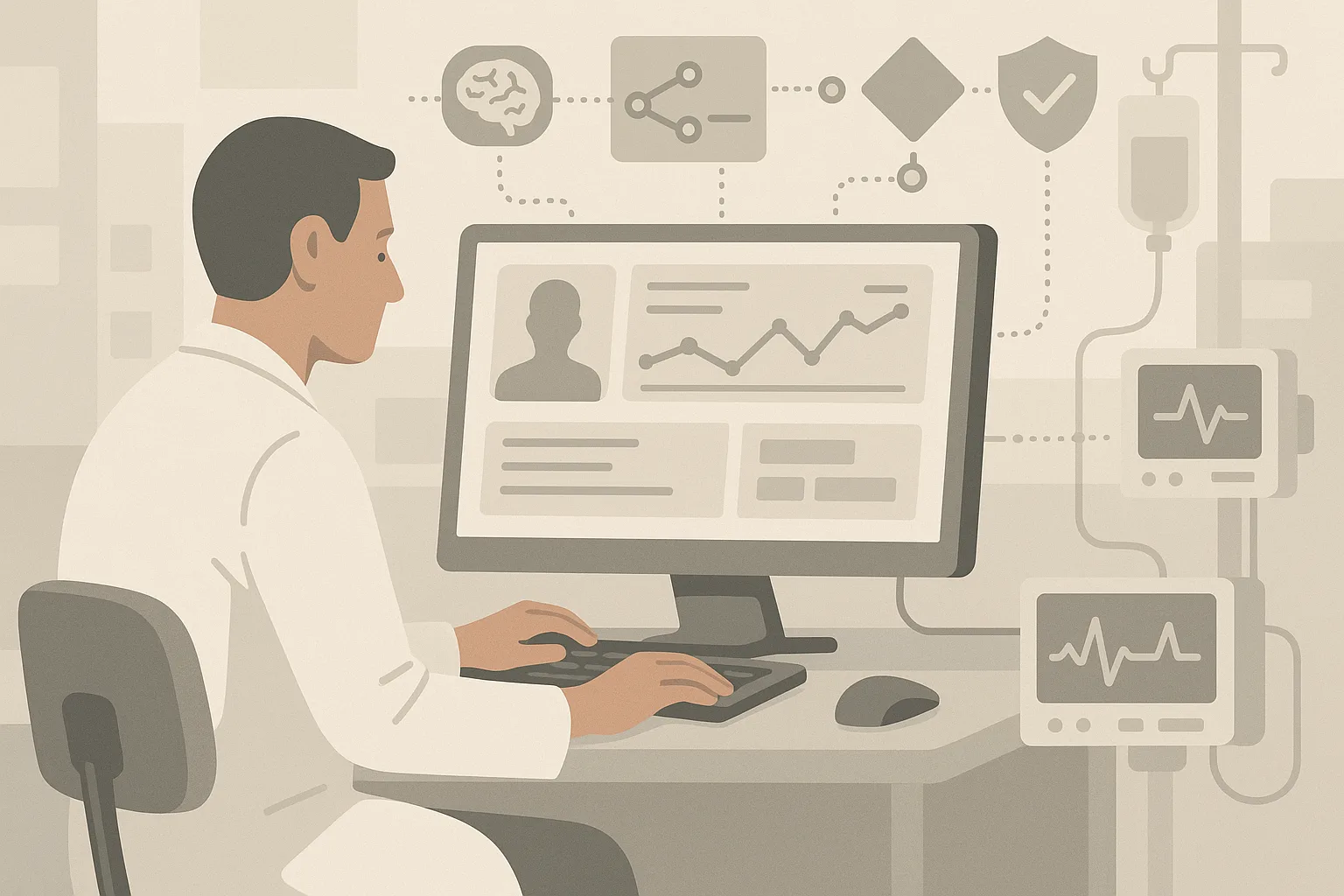
Editorial-style illustration of a modern hospital operations environment with abstract AI system layers: clinicians at w...

Executive Snapshot

Key takeaways from this issue

Buying criteria are moving from “accuracy” to “assurance”

Across AI Digital Health & SaMD, decision-makers are likely to weigh evidence quality, post-deployment monitoring, and governance controls as heavily as model performance claims—especially where outputs influence clinical decisions.

Workflow integration is becoming the hidden product requirement

Even strong models can stall if they add clicks, create ambiguous responsibility, or fail to land in existing EHR/clinical pathways. Vendors that design for adoption (not just inference) are better positioned for scale.

Regulatory expectations are converging with operational expectations

Regardless of formal classification, providers are increasingly treating AI tools as safety-relevant systems: change control, auditability, incident response, and documentation are becoming baseline asks in procurement.

The next competitive wedge: lifecycle management and measurability

As core algorithms commoditize, differentiation is likely to shift to model update discipline, drift detection, real-world performance reporting, and the ability to prove impact without disrupting care teams.

Market Signals to Watch

Key developments shaping the market

Provider Signal

Clinical governance is expanding to include AI stewardship

Health systems are increasingly formalizing review pathways for AI tools—covering validation, intended use, escalation routes, and accountability for decisions influenced by software outputs.

Why it matters: This suggests sales cycles will hinge on whether vendors can supply governance-ready artifacts (risk analysis, monitoring plans, audit trails) rather than relying on pilot enthusiasm alone.

Interoperability Signal

Integration demands are shifting from “API access” to “workflow determinism”

Buyers are likely to ask not just whether a tool connects, but where outputs appear, who sees them, how they trigger downstream actions, and how exceptions are handled within existing clinical systems.

Why it matters: This raises the bar for vendors: integration becomes a product discipline (order sets, inbox routing, documentation pathways), not a services project.

Technology Signal

Post-deployment monitoring and change management are becoming core features

AI SaMD tools are increasingly expected to include performance monitoring, drift detection approaches, versioning discipline, and mechanisms to manage updates without breaking clinical trust.

Why it matters: The market is moving toward “managed models”—systems that can be supervised, not just installed—favoring vendors with mature MLOps + clinical quality management alignment.

Competitive Signal

Point solutions face pressure as platforms bundle AI into broader suites

Standalone AI applications may encounter competitive pressure from EHR-adjacent and enterprise workflow vendors embedding AI features into existing contracts and user interfaces.

Why it matters: Pure-play AI SaMD vendors may need sharper clinical specificity, measurable outcomes, and lower integration friction to defend budget and mindshare.

Reimbursement Signal

ROI narratives are tightening: outcomes, efficiency, and liability avoidance

Procurement teams are likely to demand credible, locally measurable value cases—cycle-time reduction, avoided downstream utilization, improved documentation quality, or standardized triage—rather than generic promises.

Why it matters: This encourages designs that produce auditable metrics and adoption analytics, enabling value realization without burdening clinicians.

Deep Dive

In-depth analysis of a key topic

Why AI SaMD is being evaluated like a clinical service—not a software feature

AI Digital Health & SaMD is entering a phase where procurement and clinical leaders treat algorithms as only one component of a broader managed capability. The practical question is no longer “Can the model predict?” but “Can we safely operate this in our environment, at scale, with defensible oversight?” This reframing is driven by the reality that many AI outputs influence clinician attention, documentation, triage, imaging reads, or care coordination—even when the tool is marketed as “decision support.”

In this operating-model view, evidence expectations expand. Buyers are likely to look for clarity on intended use, failure modes, and human-in-the-loop roles: Who is expected to act on the output, within what timeframe, and under what clinical conditions? Ambiguity here creates adoption risk (clinicians ignore it) and safety risk (clinicians over-trust it). Vendors that translate model behavior into clear operational boundaries—supported by training, UI design, and escalation pathways—reduce both risks.

Next comes lifecycle management. Unlike static medical devices, AI tools may be updated, retrained, or tuned, and they can degrade when patient mix, clinical practice, devices, or data pipelines change. Providers therefore are likely to demand a change-control discipline: versioning, release notes that matter clinically, re-validation expectations, and a monitoring plan that detects drift or systematic bias. The vendor’s ability to present ongoing performance reporting in a way that aligns with clinical quality processes increasingly becomes part of the “product.”

Integration is where many deployments succeed or fail. AI SaMD that requires clinicians to open separate dashboards, reconcile conflicting patient identifiers, or manually transcribe results tends to suffer from low sustained use. In contrast, tools that land in existing workflows—orders, imaging worklists, clinical notes, messaging queues—can create consistent behavior with minimal cognitive overhead. This suggests the integration spec should be treated as a safety spec: it determines who sees the output, whether it is acted upon, and how errors are surfaced.

Finally, accountability is emerging as a differentiator. Health systems are likely to insist on clear division of responsibilities: what the vendor monitors, what the provider monitors, and what triggers incident management. When something goes wrong, leaders want to know whether the system can support auditability—what the model output was, what the user saw, what actions were taken, and which version was active. Vendors that cannot provide this level of traceability may find themselves excluded from higher-acuity use cases.

The net effect is that AI SaMD is converging toward a “service-like” procurement posture: ongoing monitoring, defined governance, measurable outcomes, and operational readiness. Vendors that package these elements as standard—rather than bespoke services—are likely to scale more efficiently, while providers may increasingly standardize AI intake and oversight to reduce variance across tools.


Key takeaway

In AI SaMD, sustainable adoption is increasingly determined by governance, lifecycle controls, workflow integration, and auditability—not just model performance claims.

Procurement reality check

If an AI SaMD vendor cannot explain how performance is monitored post go-live, how updates are controlled, and how outputs are audited inside the clinical workflow, many providers will treat the tool as a pilot—not a system of record.

Key Takeaways

  1. Expect buyer scrutiny to focus on operational assurance: monitoring, audit trails, change control, and governance artifacts.

  2. Treat interoperability as workflow design—where the output appears and how it triggers action matters as much as the API.

  3. Competitive pressure will likely intensify from suite vendors embedding AI into existing clinical systems; point solutions must prove measurable impact with low friction.

  4. Lifecycle management capabilities (drift detection, versioning, real-world performance reporting) are becoming product requirements, not optional add-ons.

  5. AI SaMD commercialization is trending toward a managed clinical capability, with shared accountability between vendor and provider.

Insights

Related Blogs

Newsroom

Related Press Releases

Related Research

Related Reports

AI-Based Stroke Detection & Triage Platforms Market

USD 2.11 Billion

AI-Based Stroke Detection & Triage Platforms Market

The AI-based stroke detection and triage platforms market comprises software that analyzes medical imaging and related clinical data to accelerate identification, notification, triage and workflow coordination for patients with suspected acute stroke. Platforms increasingly support large-vessel occlusion detection, non-contrast CT assessment, CT angiography, CT perfusion and communication between emergency, radiology and neurovascular teams. Commercial growth is supported by the urgent need to shorten stroke workflows, expanding AI adoption in emergency…

CAGR
+22%
Forecast period
2026-2036

MedInsight Newsletter

Stay Ahead of Healthcare Markets

Market intelligence, emerging trends and research updates delivered to your inbox.

We use your address only to send healthcare market research updates. Unsubscribe at any time.

Need a Market View Built for Your Decision?

Get custom research on any market in the healthcare ecosystem, tailored to your business question. An analyst will scope the work, agree the method with you and deliver a model you can interrogate.

  • Named analyst on every engagement
  • Scoped in 48 hours
  • Assumptions shared, not hidden
  • Quarterly refresh included